Friday, July 12, 2013

Tree on 3 North


The North golf Course was built over several years in phases. Holes 1,2, and 18 were originally a three hole practice loop built in1998.  As Forest Creek grew and new roads and new sections were developed the golf course grew with it.   Before any work could take place, a routing was developed  by Fazio Design. This routing showed the envelopes for the golf holes.  Based on that routing, clearing limits were flagged for the various holes with different widths at different areas of the hole.  The clearing limits were different at the tees, at the greens, and in the landing areas. Finally in 2001 we began work on new holes 3,4, and 5.

The golf maintenance staff was part of the clearing and construction team.  The third hole presented exceptional challenges, because the existing grade of the hole was running perpendicular the  direction which the hole was playing. Part of the hole clearing process involves designating which trees must be removed and which trees should be saved.  The reality of this third hole was that there was only one oak tree which had any size and quality worth saving.  That tree is the tree in the waste bunker on the left between the first and second landing area. The golf hole was shaped around this oak tree.

We often hear questions about the appropriateness of this tree as it does effect play.  It has certainly grown and is far larger and far healthier than it was in 2001.  Whether it should stay or be trimmed is a subject for open discussion. It does not effect play as much as the Eisenhower tree at Augusta nor is it as picturesque as the cypress tree which formerly stood on 18 at Pebble Beach.  However, everyone needs to know that thought by the designers went into leaving that oak tree on 3 and thought should go into whether it should stay. The following three pictures show how the size and appearance of this tree has changed over the years. Let us know how you feel about this oak tree.


2013

2001


2004

Wednesday, July 10, 2013

Aerification and Transition

AERIFICATION

Yesterday we began the cultural program of aerifying our golf  holes to promote healthy turf and firmer turf. We are doing this program differently this summer than in years past. Previously, we did not close any holes  for the aerification of fairways and rough. We would aerify and  clean up each hole before we moved on to  the next hole. The idea was that this caused minimal disruption to an individual's round of golf because they would experience only one hole which was " messed up".  Unfortunately we were unable to be as efficient as we would have liked and did not aerify each hole as completely as we would liked.  This year we are closing nine holes at a time so we can do a more thorough job on each " nine".  We have blocked off a period of two weeks for each of the four " nines".  It may not take the full two weeks to accomplish our work. We will open the closed" nine" as soon as we are finished and move on to another nine holes. For the next several weeks we will only have 27 holes available for play.

The process of aerification is common to all golf courses. The intensity of that aerification will vary. Anyone who skips greens aerification is asking for trouble. The regular aerification of bentgrass fairways is also crucial to their health. Bermuda grass fairways can thrive wthout aerification but their playing characteristics will suffer over time.  The optimum time to aerify bermuda grass fairways is the summer when they are actively growing.  They respond well to aerification, verticutting and topdressing.

Since it is our goal to provide excellent playing conditions at Forest Creek, we decided to undertake a very intensive aerification and topdressing program of our fairways and roughs this summer.  We felt that the inconvenience of closing one" nine" of our 36 hole complex was offset by the opportunity to improve the health of our turf and the playing characteristics of our fairways.

We are using pull behind aerifiers with 3/4 inch tines on the fairways and rough and walk behind aerifiers with 1/2 tines on the tees and approaches. We are chopping the plugs to add mineral matter back into the soil profile.  We are topdressing the approaches and wet areas with sand to promote a firm playing surface.
The opening of columns in the turf canopy with aerification promotes a health plant by allowing the exchange of water and air into the soil profile. This process involves the use many pieces of turf  maintenance equipment and many different personnel performing different tasks.  The turf is aerified, the plugs are broken up, the remaining thatch is removed, the turf is then mowed, and finally appropriate areas are topdressed.. The goal is firm fast healthy fairways.


Aerifying around greens


Aerifying fairways

Aeifying rough
Plugs in fairway


Chopping plugs
Topdressing fairways
TRANSITION

The transition of the South golf course from overseeded ryegrass to bermuda grass has been progressing nicely.  The aerification process we are engaging in now, helps with transition.  The aerification of areas which have been damaged from spring dead spot is a practice recommended by the universities and the USGA to promote recovery from this disease.  Other areas which will benefit from this practice are areas which show damage from excessive traffic when the turf was dormant and areas which are weak from winter time shade. The following three pictures show improvement in the Long Tee on 17 South over the last several weeks. While there is still need for further growth of the Bermuda, it is  moving and continuing to cover the bare areas.  We feel we are on schedule for a good recovery.

June 20
June 26


July 6

TEE WORK

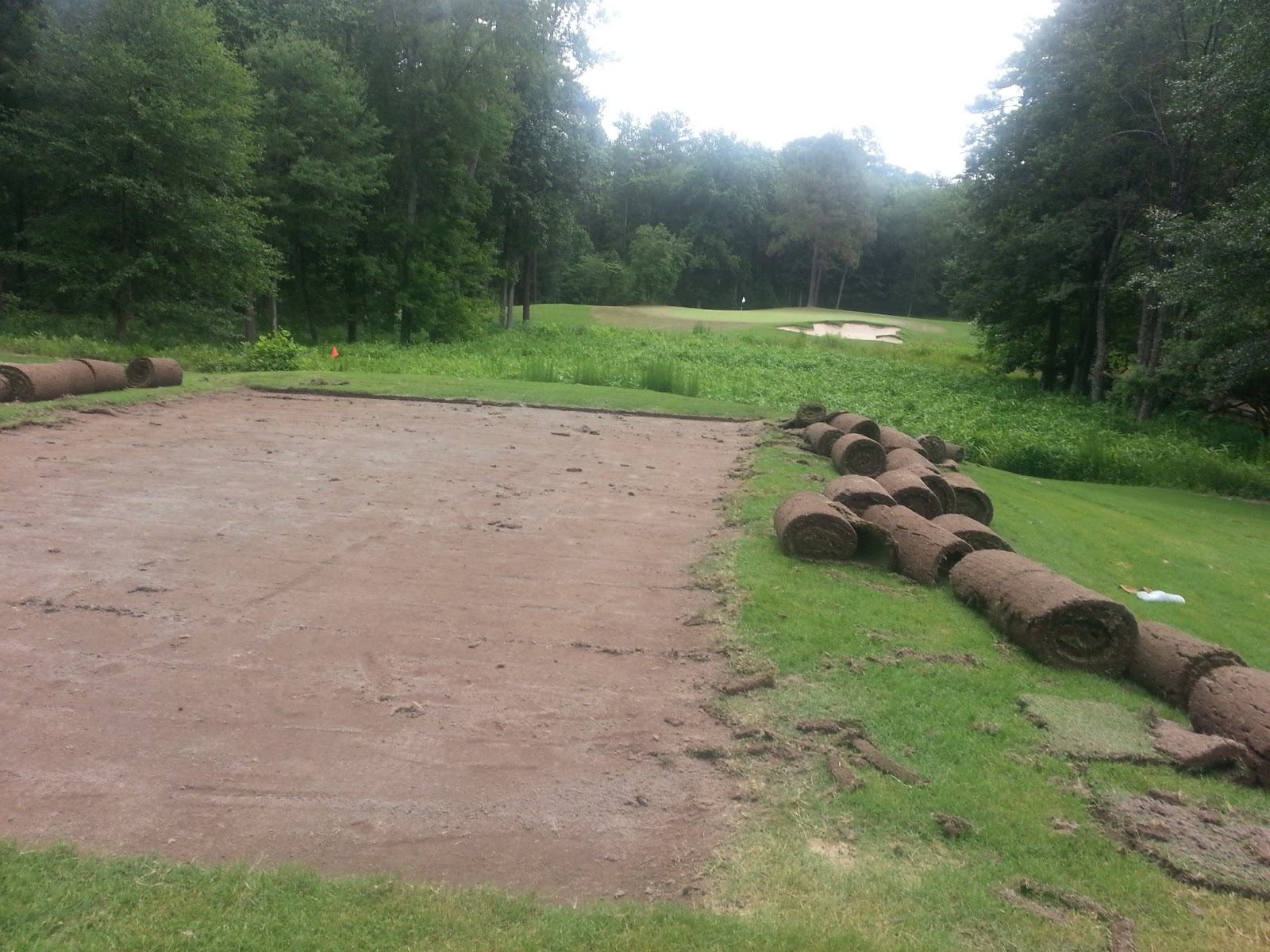
The closing of the front nine for aerification has allowed us to do work on the second hole leveling the Short Tee.  When a narrow tee is used extensively and divots are filled with sand in the same general area for a number of years, that area will become "crowned". We want our tees to be flat. They are generally built with 1% slope right to left. They should not have a hump in the middle. To fix this, we removed the sod from the tee, graded the surface back to flat and placed the sod back onto the tee. It should be ready to use when we open this nine back up for play.

Wednesday, June 26, 2013

Wet areas; irrigation, rain, or groundwater?


The modern American golf course has an irrigation system composed of hundreds of sprinkler heads, computer controllers and pump stations capable of pushing millions of gallons of water to irrigate the golf course.  The purpose of the irrigation system is to supplement natural rainfall in order to keep the turfgrass plant healthy. When the game of golf evolved in Scotland it was played on fescue in seaside settings on sandy well drained soils.  As the game moved around the world it came to be played in different climates and  different grass species were utilized. Nevertheless, the desired playing conditions did not change. The modern irrigation system became one of the tools used to create good golf course playing conditions. The restrained and judicious use of that modern irrigation system is necessary to create ideal playing conditions.

Living in the Sandhills of North Carolina, we are blessed with soils that are typically well drained. However, not everywhere is sandy. Under these rolling sandhills at various depths is a subsoil of clay.  Where the sand and the clay intersect you will find groundwater emerging to create the many streams and wetlands on the Forest Creek site. We estimate that under normal conditions, approximately 500,00 gallons of water "springs" up on the Forest Creek site each day filling our lakes. Natural rainfall adds even more water to our lakes. The location of these groundwater springs changes seasonally based on the depth of the water table.  In the summer,  most of the springs on site will dry up.  Many of the streams will stop running in the summer as the water table lowers. Heavy rains move quickly into our sandy soils causing the water table level to rise.  We will then see the groundwater emerge in different places. The routing of the Forest Creek golf courses traverses sandy hills and crosses numerous wetlands.  As the golf holes were shaped and the soil profile was changed,  thousands of feet of drainage pipe were installed to move goundwater off of the golf courses. Thousands of additional feet of drainage has been installed in the years since construction.  The goal was and still is firm and dry playing conditions.


Several years ago, when Jim Hyler was president of the USGA, that organization adopted the mantra that in regard to playing conditions, brown should become the new green.  In other words, firm, fast, brown conditions are superior to lush green conditions. Firm, fast and brown conditions are dry conditions. It is environmentally more responsible to manage the turf in a manner which creates brown conditions than one which creates lush green turf. The golf course superintendent should use their irrigation system to keep the turfgrass healthy but should not use the irrigation system to manage for color.  A healthy brown plant is preferred over a lush green plant.

There are presently wet areas on many areas in the fairways of the North golf course.  When we see a wet area we ask ourselves if there is a problem with the irrigation system.  We ask ourselves are we overwatering.  We are also concerned with  leaks in the irrigation system.  The irrigation system is a grid of rubber gasketed pipe. The system is maintained at a pressure of 120 PSI so leaks do regularly occur. If we suspect that a wet area is caused by a leak , we will valve off the irrigation system to see whether the wet areas will recede. We also analyse the location of our internal drainage  in reference to wet areas as this indicates where springs have occured in the past.  We believe that most all of these wet areas on the North golf course presently presenting themselves in the fairways are groundwater. Our heavy spring and summer rains have raised the water table and caused seasonal springs to present themselves in the soil profile above the drainage system. We cannot control the rain.  We try and control our use of the  irrigation system.  We cannot control the water table but we can try and manage it with drain lines.


Next week, we will begin extending our existing drainage systems into these problem wet fairway areas.  We will prioritize the drainage projects based upon their severity.  Most of these wet areas will dry up naturally as the water table recedes.  However they will  come back when we experience more heavy rainfall.

It is our goal to irrigate as little as possible to keep the turfgrass plant healthy.  There are times when we will water more than we would prefer such as ryegrass establishment and transition. There will be times when we have programmed our irrigation system to water and we get unexpected rainfall causing us to contribute to wet conditions.   There are times when the rainfall will be excessive and wet areas will occur.  But we will always strive to achieve playing conditions that are firm and fast rather than lush and green.


Thursday, June 20, 2013

Chipping Green Renovation

The project to renovate the chipping green is progressing but is about a week behind schedule.  There are several reasons for the delay, but the most prominent reason is weather.  First we had tropical storm Andrea dump seven inches of rain on the property.  Six days later we had a huge straight line wind storm known as a "derecho" move across North Carolina and cause major tree damage.  I have experienced floods, hurricanes, and tornadoes but that was my first "derecho". Friday morning half of Moore County was without electricity from storm damage.  Wind damage was extensive with over twenty major trees coming down. Some fell with their roots looking like a pancake and many others snapped off somewhere in their trunk.  Two woodpecker cavity trees suffered the fate of snapping. All golf course resources, both personnel and equipment were dedicated to the cleanup. It was a mess with broken branches, leaves and pine cones everywhere. We lost several days of work to a tropical storm and several days to a derecho. We are still cleaning up the golf course perimeters.


Finally last week we were able to resume shaping the new green and irrigation will be installed on the new chipping green today.  We will be visited by Blake Bickford of Fazio Golf Design on Tuesday for architectural approval. We are scheduled for installation of "Celebration" Bermuda grass sod around the green on Wednesday.  We will sprig "Miniverde" ultradwarf Bermuda to the green surface on Thursday or Friday. The new green should be about 5500 square feet. We will have continuous Bermuda grass from the putting green to the chipping green. Going forward there will be suitable space for more than one person to practice in that area safely.


This chipping green is being built as a California style green rather than as a USGA style green.  This decision was made with input from the golf course architect as well as the turf grass professionals who sell and install the ultradwarf Bermuda grasses.  The style of construction will not affect the way the green plays but does affect the cost and difficulty of construction.  We were careful to make sure that the growing medium for the new green was a uniform silty sand. We removed the old internal drainage and mixed the sublayer of drainage into the old greens mix and capped it with our silty sand. We feel that this method will create a very good soil profile for growing Bermuda grass. The perched water table of a USGA style green is important for growing bentgrass but not so much  for bermuda grass.


Our Champion bermuda grass green which was planted two weeks ago is progressing nicely.  The sprigs have developed their own root system and stolons are just beginning to run outward from the lines where the sprigs were cut into the sand. The lines you see are typical of a bermuda grass grow in. The areas between the lines will fill in over the next few weeks.


Unfortunately, we are seeing more damage in the bermuda grass during transition this year than we had hoped for. The picture above is an extreme example.  We are seeing regrowth from the interior of most areas and have applied fertilizer to the entire golf course to promote growth.  Areas which do not recover over the next several weeks will be sodded.  It was a very late spring and the ryegrass lasted longer than normal.  Until we killed the ryegrass the bermuda could not recover.

Wednesday, June 12, 2013

Ryegrass, overseeding and transition

Ryegrass overseeding has a long tradition at Forest Creek.  We began overseeding in 1995 as a way to stabilize the newly sprigged golf course through the winter of 1996.  Some of the golf holes had been sprigged so late in the summer that turf density of the Bermuda grass was insufficient going into dormancy. The new and growing membership as well as the golf course architect liked the look and playability of overseeded ryegrass and we continued overseeding.  At that time in Pinehurst, the only golf courses overseeding  "wall to wall"were Pine Needles, Highland Hills and Forest Creek.  For many years we were loved by the seed merchants in Oregon as each year we would buy 100,000 pounds of ryegrass. Typically we would overseed at a rate of 400 to 500 pounds to the acre.

In the spring of the year when  ryegrass is at its peak, the aesthetics of mowing patterns and step cuts allow the golf course superintendent to create visually striking golf holes. Ryegrass in this part of the country will die in the heat of the summer and must be reestablished every fall.  Also because we are on the northern edge of the climatic zone which is suitable for overseeding,  the timing of fall establishment is tricky.  If you go too early you will lose the seedlings to heat and  disease.  If the overseeding is done too late in the fall then there is insufficient warm weather in which to mature the ryegrass plant.  Experience has shown us that the optimum time frame for overseeding is between September 15 and October 15. Immediately after overseeding there is a period of heavy watering for grass germination and establishment.  This is also one of our most popular times of the year for golf because of the excellent weather.  Everyone wants to play but no one wants to play on a wet soggy golf course. Thus we have found that no one likes overseeding in the fall and everyone likes overseeding in the spring .Other golfing areas have an easier time with ryegrass overseeding than we do because of a longer growing season. Places like Florida or the desert southwest might see their ryegrass grow all winter long whereas our ryegrass will shut down its growth with a hard freeze and not grow again until spring.

The other issue with ryegrass overseeding is the transition from being a polystand  of rye and Bermuda grasses to a mono stand of Bermuda as the weather becomes hotter. We are going through this transition on the South golf course right now. The transition process has been made easier by the introduction of new group of herbicides called " sulfanated ureas". We now have a group of herbicides that have been designed to kill ryegrass and poa annua without injuring the Bermuda grass.  These chemicals speed up the transition and lengthen the growing season for the Bermuda. Transition  can be ugly.  Rarely is the Bermuda grass perfect when the ryegrass is removed.  But with fertilization and patience the Bermuda usually fills back in.  Transition also exposes areas which have experienced injury over the winter from traffic or  "spring dead spot", a difficult and expensive disease to control..

We have found that by overseeding one golf course and leaving the other unoverseeded we can give very good playing conditions on one of our golf courses at all times.  In the fall the Bermuda grass golf course going into dormancy is preferred by most players.  In the spring the ryegrass golf course seems to be the favorite. These processes are difficult but they are undertaken to give the golfer a playing surface to enjoy.

Blog Archive